
Ecclesiastes 3:1, 7b) (NASB)
1 There is an appointed time for everything. And there is a time for every event under heaven…
7b) A time to be silent and a time to speak.

Prayer and Bible study are two activities each Christian needs to cultivate. Scripture contains many examples of prayer. The one I especially love is the Lord’s Prayer. It is the prayer Jesus gave His followers when they asked Him how to pray. It is simple. It is short. Yet it offers great depth of understanding about God and about those who pray to Him. For example the opening ‘Our Father’ shows us who God is and who we are in relation to Him. Other profound insights reveal themselves as we become more and more familiar with the prayer. Both Bible Study and prayer are about God and about us in relation to Him. But the two should not be merged. I recently read a book, Prayerfulness, by Dr Peter Adam where the author advised Christians to merge the two by “praying God’s words back to Him” as soon as a Bible passage is read. Sorry, I find this practice offensive. It risks encouraging a dismissive attitude towards the Bible – God speaking His words to us.
Photo by M Kamran Arvi on Pexels.com
As an aside, I have to mention that Peter Adam was a significant theology lecturer for me back in the day at Ridley College. I was there to understand Church doctrine in its full orthodoxy. I turned up to Ridley College a modalist and became a Trinitarian. Modalism, if you don’t know, is the incorrect belief that the members of the Godhead, Father, Son and Holy Spirit, are not three Persons but rather three manifestations of God. Trinitarian belief involves belief in one God who exists as three individual Persons, Father, Son and Holy Spirit. Peter Adam was instrumental in helping me understand this. There were several such doctrinal corrections I was grateful for. I never thanked him for these at the time but as a member of the class I was grateful. One particular teaching point concerned the Theotokos, the title to be bestowed on Mary the mother of Jesus following the third ecumenical Council of the Church, held at Ephesus in 431 AD. Theotokos means “God-bearer” or “Mother of God”. The Orthodox and Catholics speak of the Mother of God. The Council decided against the Patriarch of Constantinople at the time, Nestorius, labelling him a heretic for not laying enough stress on the divinity of Jesus because he prefered the title Chistotokos or “Christ-bearer” to Theotokos. I’m afraid that here I have to plead heresy because I side with Nestorius on this one. We are told in Scripture that the Virgin Mary conceived Jesus Christ through the Holy Spirit coming upon her. This describes an event and implications are drawn from the brief biblical description we are given. The theology of the Theotokos was especially important to me for better understanding my Greek Orthodox mother. She referred to Mary as the Mother of God. One day I rhetorically put to her the question, “Does God have a mother?”. I was expressing frustration through ignorance of the theological debates behind the term. My lecturer clarified to the class what was at stake in that word, Theotokos. He had no idea of the place of this theology in my life. I had never mentioned it to him. The teaching that viewed Mary as the Mother of God served to underline that Jesus is God, the second Member of the holy Trinity. This clarification helped me to be more understanding of my mother but I did not take up the term myself. I believe that in trying to preserve the doctrine of the divinity of Christ, the tradition that adheres to Theotokos teaching oversteps the mark unnecessarily and creates problems for understanding who the Virgin Mary was and much more.
All of this to make clear that I am grateful to Peter Adam for what he taught in those theology classes all those years ago. The same applies to people I watch on YouTube from all sorts of theological traditions, from Baptist to Lutheran to Anglican to Presbyterian to Catholic to Orthodox – I’m grateful to them all for the truth they express but I’m not going to agree with everything all of them say all of the time. This is one reason I so like Albert Barnes, American Bible commentator and pastor of the 19th century. He showed a spirit of wisdom and forebearance, stating that Christians can’t be expected to agree on all things all of the time. So true. Yet here I am disagreeing for what I believe are important reasons.
Dr Adam’s book gives equal footing to the need for prayer and Bible study in the Christian’s life. So far I agree. A significant theme of his book is that we turn our Bible reading into prayer by “praying God’s words back to Him”. I will focus on this now through looking at the biblical example the author uses to justify his thesis. It comes from Zechariah 7:13. Dr Adam believes that God’s turning away from His people in Zechariah’s time, His not hearing their words, was because they did not “pray God’s words back to Him”. Is this what Zechariah communicated? Here is Zechariah 7:13 in context:
Zechariah 7:8-14 (NASB) 8 Then the word of the LORD came to Zechariah saying, 9 “Thus has the LORD of hosts said, ‘Dispense true justice and practice kindness and compassion each to his brother; 10 and do not oppress the widow or the orphan, the stranger or the poor; and do not devise evil in your hearts against one another.’ 11 But they refused to pay attention and turned a stubborn shoulder and stopped their ears from hearing. 12 They made their hearts like flint so that they could not hear the law and the words which the LORD of hosts had sent by His Spirit through the former prophets; therefore great wrath came from the LORD of hosts. 13 And just as He called and they would not listen, so they called and I would not listen,” says the LORD of hosts; 14 “but I scattered them with a storm wind among all the nations whom they have not known. Thus the land is desolated behind them so that no one went back and forth, for they made the pleasant land desolate.”
I don’t know how much clearer the passage could be in asserting that God turned away and ignored His people because of their wrong actions, actions that did not reflect God’s character. What God wanted from His people had been conveyed to them over and over again, starting with Moses and continuing on through the succeeding prophets of God. The Bible makes clear that God’s displeasure and punishment of the Israelites arose because of their gross immorality and nonchalance over the needs of the truly vulnerable, their deceptive practices, their idolatry and their apostasy from Yahweh. They kept up external practices while they denied God true obedience and worship. Why would someone not see what is to me clear scriptural teaching? The only reason I can think of is to justify certain theological understandings. I do not believe theology should overrule our acceptance of what is on the biblical page. I know, this opens up a hornet’s nest because interpretation depends upon our exegetical approach. Which is why we turn to Bible scholars so this all becomes very circular. All of that said, I believe that we should be able to disagree if we spot dangerous error in someone’s teaching. I find it dangerous to overlook what God wanted for His people. This is why it immediately resonated as true when I heard the late Dr Michael Heiser assert that God’s people were to live in “believing loyalty to God”. Believing loyalty places a level of responsibility on the believer to obey God, to walk this life in solidarity with God. Belief or faith is not just a mind assent thing although I believe that we are saved by believing in Jesus Christ’s atoning work for us on the cross. But this belief, far from ruling out obedience, is tested as valid by virtue of living a life in at least attempted obedience to God. The Israelites kept externals alive but sacrificed true faith in Him, so sinking below even the immorality and idolatry of their surrounding pagan nations, if that were possible. And it was possible. It happened. Here is one description of this among many in the OT:
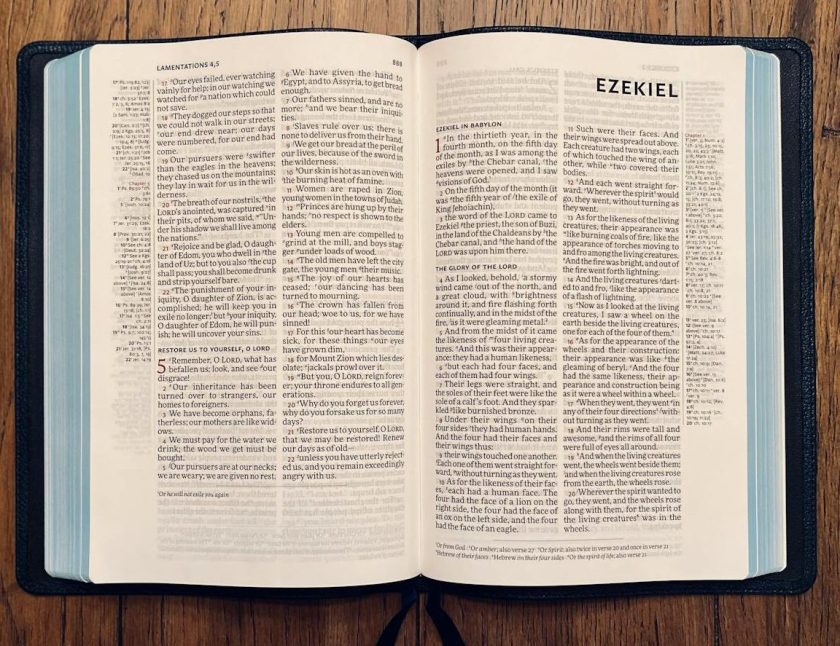
Ezekiel 5:5-8 (NASB) 5 “Thus says the Lord GOD, ‘This is Jerusalem; I have set her at the center of the nations, with lands around her. 6 But she has rebelled against My ordinances more wickedly than the nations and against My statutes more than the lands which surround her; for they have rejected My ordinances and have not walked in My statutes.’ 7 Therefore, thus says the Lord GOD, ‘Because you have more turmoil than the nations which surround you and have not walked in My statutes, nor observed My ordinances, nor observed the ordinances of the nations which surround you,’ 8 therefore, thus says the Lord GOD, ‘Behold, I, even I, am against you, and I will execute judgments among you in the sight of the nations.
No, I do not believe prayer and Bible reading should be merged. If we leap to pray instead of taking in what the Bible is saying we quickly miss the point. Foster a quiet attentiveness to what you read in Scripture. It deserves your complete attention and contemplation. Instantly repeating it back to God means you may well sacrifice its full content and impact, replacing them with your own imaginings. Remember: when you read the Bible you are hearing God speak. There is a different time when you can speak to God. We call it prayer and it should be separate from Bible study. This is not to say that you can’t spontaneously pray as you read a passage. I am just saying that there need be no compulsion to turn Bible reading into prayer. That is forcing something upon you that is an intrusion into your time of contemplating God’s word. When you read the Bible remain quiet and listen so that the text sits with you for you to meditate upon. I have set up my own writing template to study the Bible. I note what strikes me by writing it down. This helps me to internalise the Bible’s words. Don’t treat Bible study like an academic exercise. Much of the Bible should be able to tell you amazing things if you only give yourself to it in contemplation. I don’t mean you should chain yourself to the chair until you find illumination but if you pay attention to it day by day a picture of God will emerge that you may not have expected. I have found many unexpected things in Scripture but this is for another article.
It is worthwhile noting specific Bible verses for use as suitable prayers and later using them as such. It is helpful of Dr Adam to bring to the Church’s attention the need to pray with more careful deliberation. But I argue against the advice on p 112 of his book:
“Don’t read the Bible without turning your reading into a prayer…”.
James 1:19 (NASB)
19 This you know, my beloved brethren. But everyone must be quick to hear, slow to speak and slow to anger;
I urge you to separate prayer from Bible study. Pray when it is time to pray and read or study the Bible when it is time for that. Choose exclusively allotted times for both. Let those special words from God’s word sit with you, feed you. Contemplate them. Acquiring a deep and rich prayer life is an important goal. My only proviso is that Bible reading not be traded for prayer. Both must retain equal significance and honour through separating their roles in our lives.

